
How to Find Low-Competition Print-on-Demand Niches (Step-by-Step)
·7 min read
Most print-on-demand sellers lose money on the same mistake: they design first and research second. They pick a niche they personally like, make ten shirts, upload them, and wait. Nothing sells — not because the designs are bad, but because they walked into a niche where ten thousand sellers already compete for the same buyer.
This guide flips that order. Below is a repeatable method for finding low-competition print-on-demand niches — the pockets of the market where demand outweighs supply and a good design can actually surface.
TL;DR: A low-competition niche is one where buyer demand clearly exceeds the quality-adjusted supply of existing designs. Find them by combining a specific interest with a specific style ("equation thinking"), then scoring each idea on demand signals vs. real listing competition — and validating before you design, not after.
What does "low competition" actually mean?
Low competition is not "a niche nobody is in." A niche with zero sellers usually means zero buyers. What you want is asymmetry: real, provable demand sitting on top of thin or low-quality supply.
Three things have to line up:
- Demand exists — people are actively searching for and buying this kind of design.
- Supply is thin or weak — few listings target the exact phrase, or the ones that do are dated, generic, or poorly designed.
- You can enter it — the keyword and the visual angle are specific enough that one strong design can stand out.
When all three hold, a single good design has room to rank. When any one fails — no demand, saturated supply, or too broad to differentiate — the niche is a trap, however appealing it looks.
Why low-competition niches matter more in 2026
Broad categories are over. "Funny cat shirt" is not a niche; it is a battlefield with millions of listings. The market has shifted toward micro-aesthetics — the intersection of a specific identity, hobby, or moment with a specific visual style.
The practical takeaway: stop thinking in single words and start thinking in equations.
audience + specific interest + style or format = a defensible niche
"Gardening" is too broad. "No-dig gardening enthusiasts" + "vintage seed-packet illustration style" is a niche with a clear buyer, a clear look, and far fewer competitors.
The equation in action: five example niches
These are not guaranteed winners — no list is, and each still has to clear the five steps below. They are here to show what specific identity + specific style looks like in practice, versus the broad terms most sellers chase:
- No-dig gardeners + vintage seed-packet illustration — a clear identity and a distinctive look, far thinner supply than "gardening."
- Trail runners + minimalist topographic line-art — a committed hobby paired with a style that signals it without a single word.
- Sourdough bakers + hand-drawn botanical labels — a fast-growing identity with room for a craft aesthetic.
- Tabletop RPG players + retro arcade typography — a passionate community plus an unexpected style mash-up.
- New parents + understated, non-cutesy affirmations — an evergreen life-stage where most designs shout; restraint is the gap.
Notice the pattern: each names who it's for and what it looks like. Swap in your own identity and style — then run it through the five steps before committing a single design hour.
Step-by-step: how to find low-competition POD niches
Step 1 — Build a seed list from real identities
Start with people, not products. Hobbies, professions, fandoms, life stages, and beliefs are durable because they are part of how buyers see themselves. A nurse buys nurse shirts every year; a one-off meme buyer never comes back.
Brainstorm 20–30 seeds across these identity buckets, then combine them with a style or a format (retro, minimalist line-art, bold typography, "this is what an X looks like" formats).
Step 2 — Translate each seed into a buyer's search phrase
A niche only exists if buyers can find it. For each idea, write the exact phrase a buyer would type into the search bar — not your internal label. "Mindful trail running gift" is a buyer phrase. "Outdoor fitness niche" is not.
Step 3 — Read the supply side directly on the marketplace
Search that phrase on the marketplace you sell on — Amazon Merch on Demand (formerly Merch by Amazon), Etsy, or eBay — and study the first two result pages:
- How many listings target the phrase precisely? Broad, loosely-related results are a good sign — it means few sellers own the exact angle.
- How good are the existing designs? Dated, cluttered, or generic top results mean the bar is low.
- How recent are the best sellers? If the strongest listings are years old, the niche may be under-served today.
Step 4 — Score demand against competition
Now weigh the two sides. A useful mental model is a simple demand-to-supply ratio: high search interest paired with thin, weak supply is the green zone; high interest with deep, polished supply is saturated; low interest with any supply is dead.
For keyword difficulty, many sellers use a rough rule of thumb: very low difficulty scores are close to greenfield, mid-range scores are workable with strong listings and design quality, and high scores are best avoided unless you have a real edge. Treat any single difficulty number as a signal, not gospel — combine it with what you actually see on the result pages. (Scoring this across many niches by hand is slow — it is also what dedicated research tools are built to do.)
Step 5 — Validate demand before you design
Before committing design hours, confirm the interest is real and ideally growing, not fading — here is the full validation method, gate by gate. Cross-reference the trend direction of your phrase against the competition you found in Step 3. Rising interest plus thin supply is the strongest possible setup. Flat-or-falling interest, even with thin supply, is a niche to skip.
Only after a niche clears all five steps should you open your design tool.
A quick way to read the demand-vs-supply picture
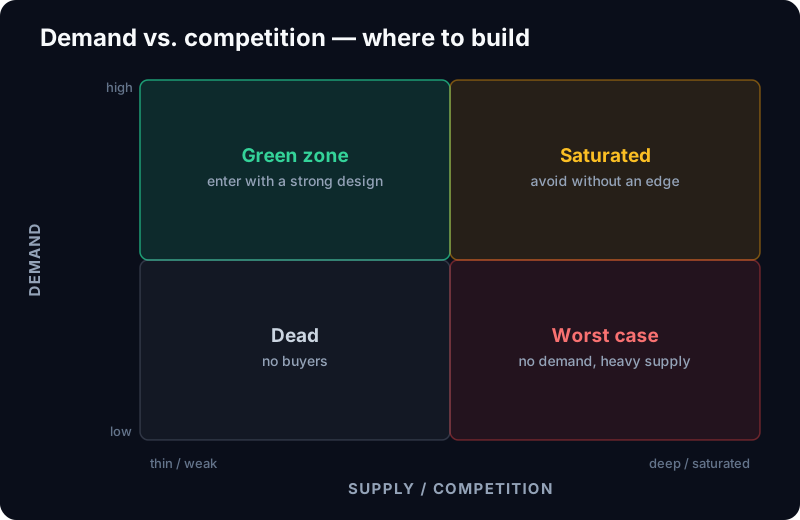
| Demand | Supply (quality-adjusted) | Verdict |
|---|---|---|
| High | Thin / weak | Green zone — enter with a strong design |
| High | Deep / polished | Saturated — avoid unless you have a clear edge |
| Rising | Thin | Best case — get in early |
| Low | Any | Dead — no buyers |
| Flat / falling | Thin | Skip — interest is leaving |
Common mistakes that kill new niches
- Designing before researching. The single most expensive habit in POD.
- Confusing "no competition" with "opportunity." Empty niches are usually empty for a reason.
- Going too broad. Broad keywords feel safe but put you against everyone.
- Chasing one-off jokes. A meme sells for a week; an identity sells every year.
- Trusting one metric. A keyword score, a trend line, or a result count alone will mislead you — read them together.
Frequently asked questions
What is a low-competition print-on-demand niche?
A niche where buyer demand is meaningfully higher than the quality-adjusted supply of existing designs — so a well-made design can rank and sell without fighting thousands of near-identical listings.
How do I check competition on Merch by Amazon or Etsy?
Search the exact phrase a buyer would use, then read the first two result pages: count how many listings target that phrase precisely, judge their design quality, and note how recent the best sellers are. Low result counts paired with weak, dated designs signal opportunity.
How long does it take a new POD niche to start selling?
It varies by marketplace and demand, but plan in weeks, not days. Marketplace ranking rewards listings that accumulate clicks and sales over time, so consistent, well-targeted designs compound rather than spike.