
How to Spot POD Trends Before They Peak
·8 min read
Most sellers meet a trend the same way: they see it on a best-seller list, on a "trending now" page, or in a competitor's shop that is suddenly everywhere. By then the trend is not a trend — it is a crowd. The window where a good design could rank and sell has already closed, and every upload from here fights hundreds of near-identical listings.
Spotting a trend before it peaks is a different skill, and it is a learnable one. It is not fortune-telling and it is not luck. It is reading the shape of demand over time and acting while supply is still thin.
TL;DR: A print-on-demand trend makes money on the way up, not at the top. Spot trends early by tracking leading indicators (rising search interest, growing identity-based communities, early chatter) instead of lagging ones (best-seller lists, saturated result pages) — then confirm demand is real and supply is still thin before you design.
Why does timing decide whether a trend makes you money?
A design's ability to sell is not fixed — it moves with the crowd around it. The same shirt uploaded to a rising niche and a peaked one has two completely different fates.
Early, supply is thin, so a single strong design has room to surface and start accumulating the clicks and sales that marketplace ranking rewards. Late, the exact phrase is already owned by dozens of established listings with months of sales history behind them. You are not competing on design quality anymore; you are competing on a ranking head-start you do not have.
That is why timing beats effort here. A mediocre design early can outsell a brilliant design late, purely because it got there before the shelf was full.
What does a POD trend's lifecycle look like?
Almost every durable trend follows the same curve: a slow emerging phase, a steep rising phase, a crowded peak, and a decline. The entire opportunity lives on the rising slope — before the peak, after the trend is real enough to bet on.
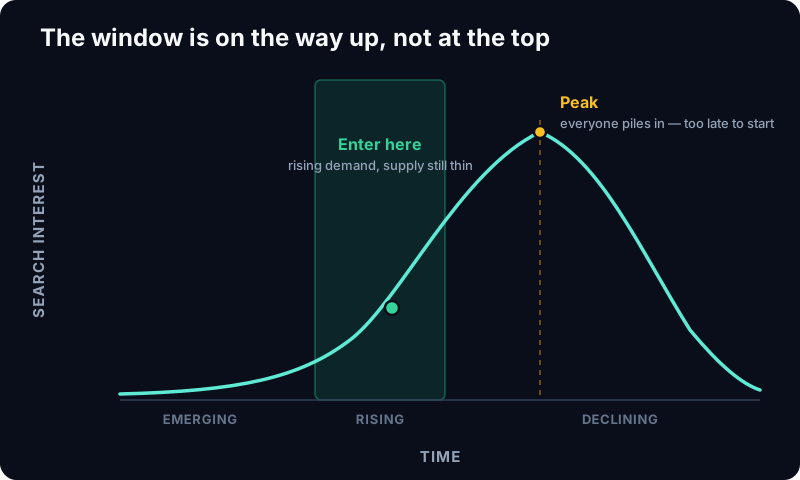
| Stage | What you see | What to do |
|---|---|---|
| Emerging | Faint, inconsistent interest; a few enthusiasts; almost no listings | Watch — too early to commit, but note it |
| Rising | Steady, accelerating interest; communities forming; supply still thin | Enter — design and upload now |
| Peak | Everywhere at once; best-seller lists; result pages filling up | Too late to start; only enter with a real edge |
| Declining | Interest fading; supply now outnumbers demand | Skip — the crowd is leaving |
The mistake almost everyone makes is treating the peak as the buy signal. The peak is the sell-out signal. The buy signal came weeks earlier, on the rising slope, when the trend was still quiet enough to feel risky.
How to spot a trend before it peaks
You cannot see the future, but you can read direction. These five habits move you from reacting to trends to catching them early.
1. Watch identities and subcultures, not products
Products trend and die. Identities compound. A durable trend almost always starts inside a specific community — a hobby, a fandom, a profession, a life stage, an aesthetic subculture — before it ever shows up as a search-volume number. Follow the identities you understand, and you will feel a shift months before a keyword tool registers it.
2. Track leading indicators, not lagging ones
The difference between early and late is entirely about which signals you trust:
- Leading (early): rising and accelerating search interest, new communities and hashtags forming, growing chatter, small sellers quietly testing the angle.
- Lagging (late): best-seller lists, "trending now" pages, result pages already full of the exact phrase, big shops all-in on it.
Lagging indicators are comfortable because they are certain — but certainty is exactly what tells you the window has closed. Trust the noisy, early signals and verify them.
3. Read the direction, not the snapshot
A single number — today's search volume, today's result count — tells you where a niche is, not where it is going. Direction is what matters. A term at moderate volume that has been climbing for eight weeks is a far better bet than a higher-volume term that has been flat or sliding. Always look at the trend line, not the trend dot. (Here is the full validation method, gate by gate.)
4. Confirm it's a trend, not a spike
Not every rise is an opportunity. A news event, a meme, or a viral moment produces a vertical spike that collapses just as fast — a fad, not a trend. Fads reward whoever is fastest to market; most sellers cannot win that race and should not try. A real trend shows sustained, repeatable interest building over weeks, tied to a durable identity. If the rise would survive the news cycle, it is a trend. If it lives and dies on one moment, let it go.
5. Check supply is still thin
Early demand is only half the setup. The other half is that competitors have not arrived yet. Search the exact buyer phrase on your marketplace — Amazon Merch on Demand (formerly Merch by Amazon), Etsy, or eBay — and read the first two result pages. Rising interest paired with thin, weak, or dated supply is the strongest possible signal: the trend is real and the shelf is still empty. (Here is how to judge competition properly.)
Early signal vs. peak signal — a quick reference
| You notice… | Stage | Meaning |
|---|---|---|
| Search interest climbing week over week | Rising | Early — act |
| A small community forming around a specific look | Emerging/Rising | Early — watch, then act |
| The phrase appears on a best-seller list | Peak | Late — crowd has arrived |
| Result pages full of near-identical listings | Peak | Late — shelf is full |
| A single-day vertical spike from a news moment | Fad | Skip unless you are fastest |
| Interest sliding after a high | Declining | Skip — leaving the party |
Where does the Daily Design Radar fit?
Doing all of this by hand is real work: monitoring communities, checking direction across many terms, separating trends from fads, and reading supply on every promising angle — every day, before anyone else does. Miss a few days and the window moves without you.
That monitoring is exactly what MerchScout's Daily Design Radar is built to remove. Every day it delivers fresh, vetted niche and design ideas — surfaced while the opportunity is still early, so you spend your time designing instead of hunting. Run with an idea directly, or use it as an inspirational starting point. The point is simple: you get to the rising slope without living on it.
Being early is a timing advantage. The Radar's job is to hand you that timing on a plate, every morning.
Common mistakes when chasing trends
- Buying at the peak. The best-seller list is where a trend goes to get crowded, not where you get in.
- Confusing a fad with a trend. One-off spikes reward speed you probably do not have; durable identities reward being early.
- Reading a snapshot instead of a direction. Today's number hides whether interest is rising or falling.
- Ignoring supply. Early demand into a full shelf is not an opportunity — check competition too.
- Waiting for certainty. By the time a trend is obviously safe, it is obviously over.
Frequently asked questions
How do you spot a print-on-demand trend before it peaks?
Watch leading indicators rather than lagging ones: rising search interest, growing communities around a specific identity, and early chatter — then confirm supply is still thin. By the time a trend is on a best-seller list, you are already late; the money is made on the rising slope, before the peak.
Can you actually predict POD trends?
You cannot predict a viral spike, and you should not try. What you can do reliably is catch durable trends early by reading direction instead of snapshots: a term with steady, accelerating interest and thin supply is an early trend; a one-day spike is noise. The goal is timing, not fortune-telling.
What is the difference between a trend and a fad in print on demand?
A trend is rising interest in a durable identity, hobby, or aesthetic that keeps selling for months or years. A fad is a one-off spike — a meme or news moment — that collapses within days. Fads reward whoever is fastest; trends reward whoever is early and consistent.